Ja.Ca.Mbé: 1.2 million 1,000 ha seedlings ready for the campaign — and field trials to plant better

Mbé (Republic of Congo) — The rainy season has just begun, so it’s the perfect time to plant. In our Mbé nursery, 1.2 million Acacia mangium seedlings, produced in two sowing sequences, are being prepared for the 1,000-hectare major campaign scheduled for the end of 2025.

Healthy, robust plants… And ready at the right time

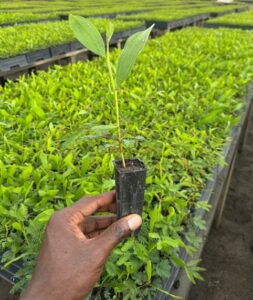
Our goal is clear: to provide healthy and vigorous seedlings, adapted to the sandy soil of the Batéké Plateau and to large-scale planting. The plants are raised in honeycomb chips with small clods to facilitate handling in the nursery as well as in the field.

The root system is our “green light”: as soon as the roots completely colonize the root ball, the plant is ready to be planted. To avoid unbalanced growth (too much foliage in relation to the roots, a source of mortality in the plantation), our teams regularly sort the plants by size and only ship healthy plants, free of diseases or pests. Before leaving, they go through a hardening phase to gradually get used to the conditions of the site. 

More than 90 people will participate in the burial.

Innovating to better restore: our 2025 technical tests

To continuously improve our practices, the Ja.Ca.Mbé project conducts technical trials in the nursery and in the field. Two axes:

  • Techniques: reduce mortality, improve germination rates, optimize the substrate, reduce the impact of soil preparation work.
  • Organizational: reduce arduousness and increase the pace of work. 

What we test in the nursery

  • Substrate & fertilization: promote a developed root network, a well-formed pivot, active nodules, with a root ball that stands for planting with a mechanical planter (pottiputki).
  • Nutrient balance: no deficiencies or excesses (both promote diseases and pests).
  • Germination: accelerate and homogenize the dynamics of Acacia mangium seeds.
  • Agroecological practices : limit tillage during planting, to preserve fertility and structure.
  • Measuring to decide: in the field, our teams carry out a spade test (soil structure) and BeerKan blower door tests to estimate permeability. In 2025, these measurements compare different methods of reduced tillage in an agroecological approach, in collaboration with TEREA (French design office) and AgroParisTech. The results will guide our choices for more resilient, efficient and soil-friendly plantings.
In short

  • 1.2 million seedlings produced in Mbé for the 1,000 ha campaign  (end of 2025).
  • Rigorous sorting and exit at the right root stage to limit mortality. 2025 trials to optimize substrate, germination and agroecological practices. Field measurements (spade test, BeerKan) and scientific partnerships to inform our decisions.